
Neuroscience & Technology
A Fly Brain Map, a Game Controller and an Uploaded Mind Are Different Claims
Fruit-fly brain simulations have appeared in games, a scrolling-phone demo and a walking robot. The scientific map is real, but each demonstration also depends on engineering choices. Here is how to distinguish the wiring, the simulation and the behavior on screen.
Watch the fly-brain explanation
Reindent video · 4 min 40 sec
Watch the full video on YouTube
The September 13 video follows a remarkable scientific resource into some very internet-shaped experiments. Its main question is simple: which part of the behavior comes from the neural model, and which part did a developer build around it?
What is a connectome?
A connectome is a map of neural wiring. It records cells and their connections. Turning that map into a working simulation requires additional choices about how those cells respond, how signals pass between them and how the model receives inputs from its surroundings.
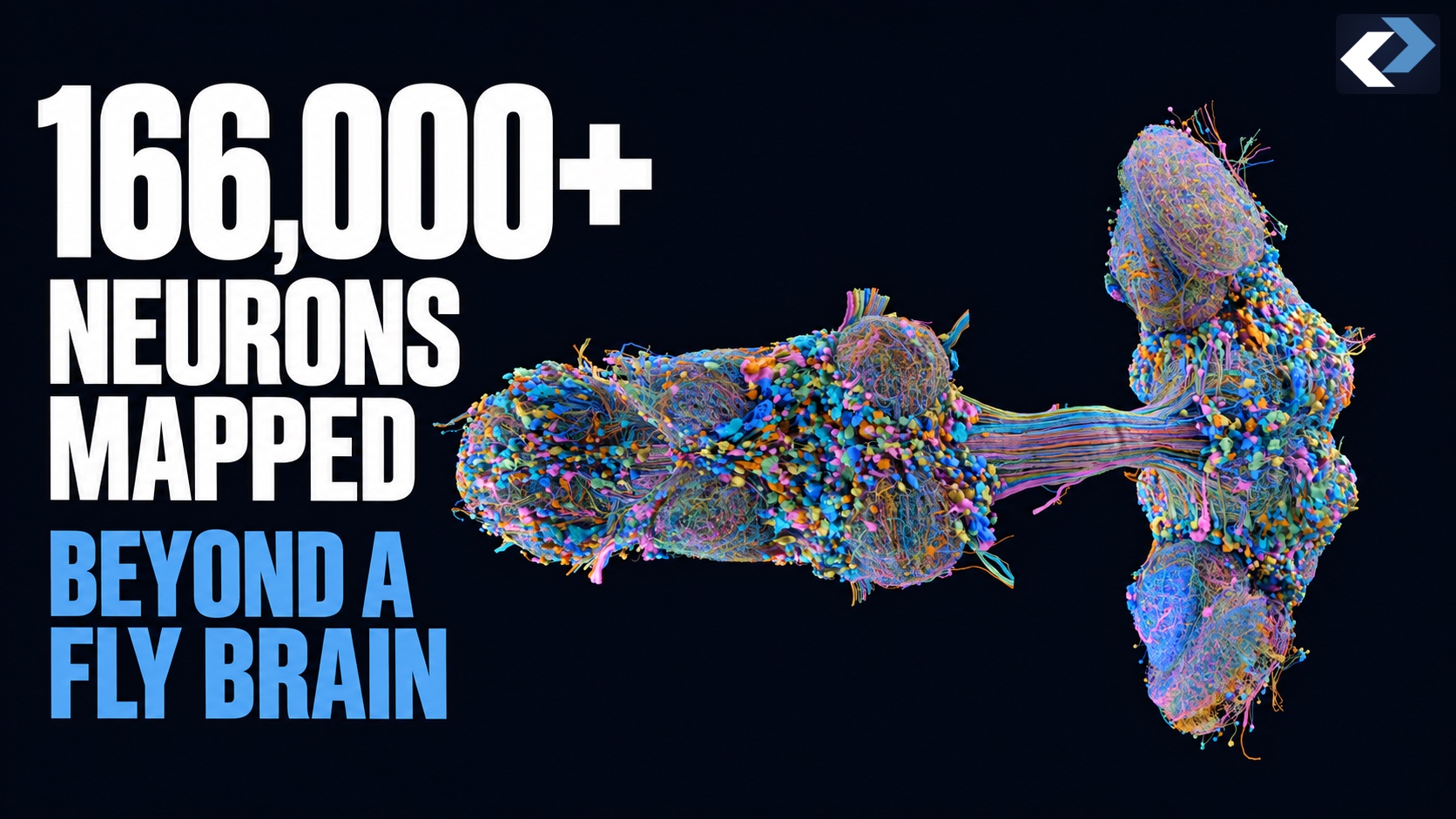
The MaleCNS project reconstructed the male fruit fly's brain and nerve cord. The work described in the video includes approximately 166,700 neurons and 125 million synaptic connections. It combines microscopy, computational reconstruction and expert checking. The project's dataset release and the later research publication are separate milestones.
That resource helps researchers investigate relationships between wiring and behavior. Downloading it does not automatically reproduce the functioning animal, its sensory experience or its mind.
Why do game demos need an interface?
A game has its own inputs and actions. A developer must decide which game events enter a neural simulation and how simulated activity becomes movement, a button press or another action. Those mappings are part of the controller.
In Evan Sinclair Smith's Minecraft demonstration, the creator describes game events entering the model and selected neuron groups influencing programmed movements. The biological wiring can contribute while the resulting behavior still depends on the surrounding code.
The ornata/fly Mario project describes hand-mapped controls without training or a reward system. Mario moving demonstrates a running connection between the simulation and the game. It does not establish that the model understands a level or has learned how to rescue anyone.
The walking-robot clip credited to Frank carries a similar limit. The creator reports an interface that turns simulated activity into motor commands. Reindent's video does not independently establish the full execution path, gait mapping or a learning result.
Did a fly learn Beat Saber or choose a video feed?
The coordinated movement in the Beat Saber demo is striking. The creator's explanation, discussed in our video, narrows the claim: the system was fitted to one track with help from replay data. That differs from demonstrating that it can learn or play arbitrary songs.
FlyTok's project connects visual input to a neural simulation and uses activity in the presentation. But its swipe is choreographed and the feed changes on a timer. The visible scrolling therefore does not show the model selecting what to watch next.
A dopamine display is also not a direct measurement of enjoyment. In the example, it reflects simulated firing with an artificial boost. It cannot establish pleasure or addiction. The kebab-chef clip in the video is simpler still: an AI-made joke, with no verified evidence of a neural model learning to prepare food.
What would count as a useful scientific result?
A separate 2024 study by Shiu and colleagues used earlier female fruit-fly wiring to build a computational model. Researchers used it to predict neurons involved in feeding behavior, then checked predictions by activating neurons in real flies.
That is a stronger test of what a model explains about an animal. The result connects a prediction to an experiment rather than relying only on an entertaining animation. It should also remain distinct from the later MaleCNS work; they are not the same dataset or study.
How should we read the next viral brain demo?
Ask what information enters the model, which outputs it controls, whether the developer trained or fitted the system, and what was tested outside the demonstration. A clear answer can make a modest claim more interesting than an exaggerated one.
The scientific achievement does not need an uploaded-mind story to matter. Detailed wiring maps, useful computational models and clever interfaces are valuable on their own. For a parallel example of separating demos from larger claims, see our analysis of GPT Image 2.5, Atlas and H3 Max.