
AI
GPT Image 2.5, World Labs Atlas and H3 Max: What the Demos Actually Show
From consistent image edits to movable cameras and interactive video, three AI tools are changing how visual experiences get made. Here is what their demos show—and where the creative possibilities still exceed the evidence.
A changing outfit, a basketball suspended in midair, and a Pokémon battle can all look like AI video. Yet the systems behind them solve different problems. Understanding those differences makes the demonstrations more useful: you can see what controls the image, what controls the camera, and what decides the action.
Watch: GPT Image 2.5, Atlas and H3 Max
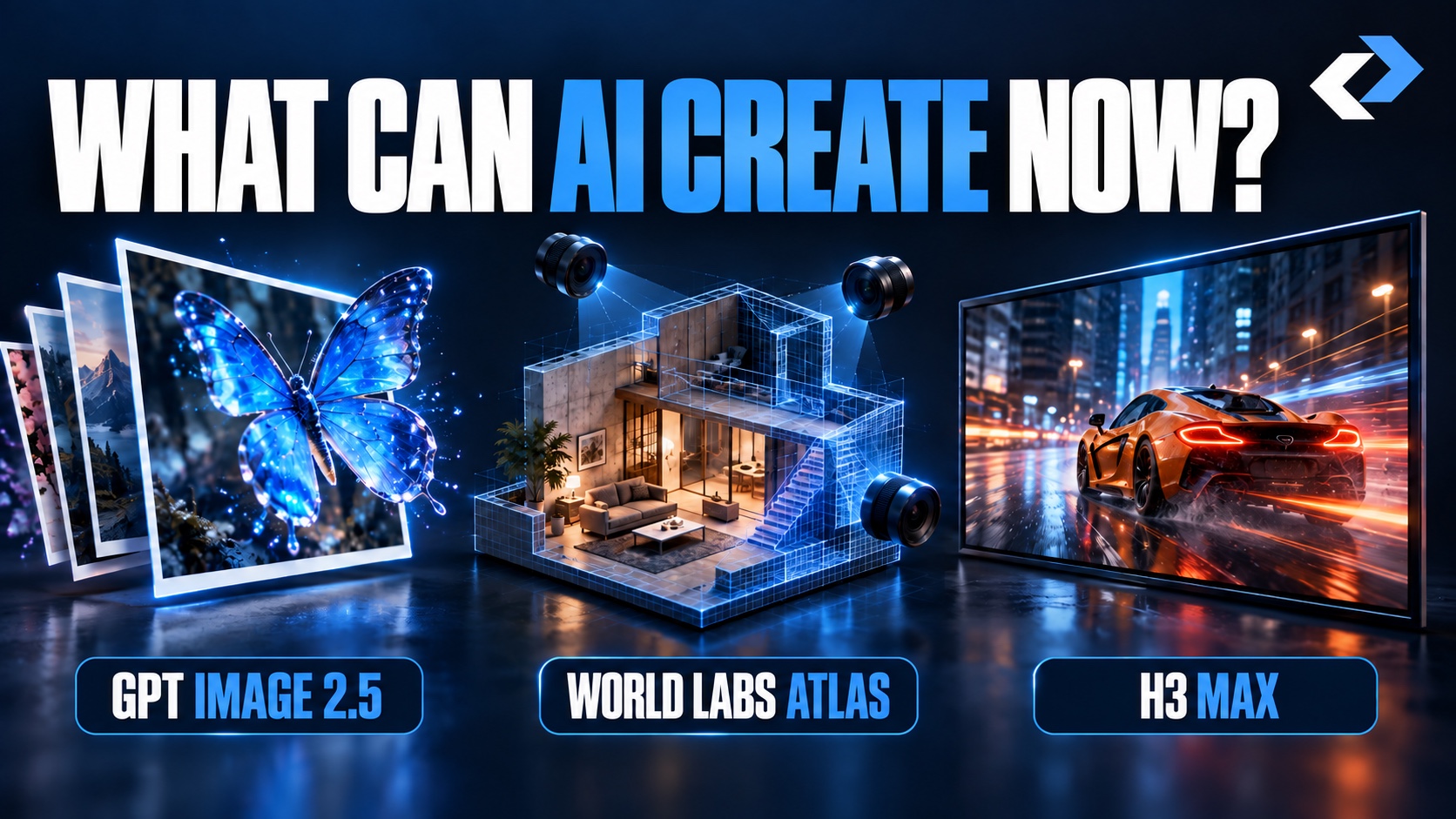
Reindent video · 2 min 9 sec
Watch GPT Image 2.5, Atlas & H3 Max on YouTube
GPT Image 2.5: Editing images into a sequence
OpenAI’s ChatGPT Images 2.5 focuses on image creation and editing. Its demonstrations change clothing, backgrounds, and styles while trying to preserve recognizable subjects. OpenAI also introduces Sketch, which lets a drawing guide the finished image. The company explicitly describes its animated editing examples as sequences of multiple images. OpenAI’s announcement
That distinction helps explain the creator experiments. Charlie Guo’s caterpillar-to-butterfly demonstration treats generated images as stop-motion frames. Ivana’s tiny dragon uses 36 generated images assembled in Codex, according to her description, with no video model involved.
The creative opportunity is continuity across deliberate edits. A creator can build a sequence by deciding what changes from image to image. The assembled result moves, but that does not turn the underlying image model into a native video generator.
World Labs Atlas: Moving the camera through a moment
Atlas addresses spatial control. World Labs demonstrates reconstructing filmed events from a few camera views, then producing viewpoints the original cameras never recorded. Its basketball and bursting-watermelon examples make the effect easy to recognize: an instant appears suspended while the perspective moves around it. World Labs says these demonstrations used three to five ordinary camera views. World Labs’ Atlas announcement
The missing viewpoints are generated. World Labs explains that Atlas fills unseen regions using plausible scene details; additional input views provide more evidence and reduce how much it must imagine. This matters when interpreting the output as a record of a real event.
Atlas also supports generating new scenes and controlling viewpoints within them. Our video includes a separate exploration preview. Reframing a captured basketball game and moving through a generated world illustrate different uses of spatial modeling. Neither demonstration, by itself, establishes a complete playable game with reliable rules or physics.
H3 Max: Generating the next cinematic
H3 Max is fal’s post-trained version of MiniMax H3, developed for video generation with lower latency. fal reports generation times shorter than playback duration for several configurations. Those are provider measurements; an interactive application still has to handle generation, delivery, and playback. fal’s H3 Max introduction
The Pokémon prototype shows one way to use that speed. A player selects a move, JavaScript game rules resolve the result, and the application generates an animation to present it. The project documents H3 Max Turbo and Reference endpoints for different cinematic inputs. The game rules decide the outcome; generated video illustrates it. Pocket Battle Lab’s architecture
That separation is useful beyond this example. A system can retain explicit rules while varying its presentation. The prototype also documents possible visual drift and waiting when the next clip arrives late, so a smooth demonstration should not be read as a guarantee of uninterrupted generation.
Infinite Slop: Viewers influence what comes next
Pieter Levels’ Infinite Slop turns the interaction toward a shared audience. Viewers write in chat to influence upcoming generated clips, and the system attempts to connect each clip with the previous one. Levels identifies fal’s accelerated H3 model as the technology enabling the experiment. Levels’ project announcement
It invites an appealing question: could a viewer someday describe a story and receive a show made for them? That is a possible direction, rather than an established result of this demonstration. A shared channel influenced by chat does not yet demonstrate a coherent, individually personalized series.
What creators can take from these demos
Our reading of these examples is that creative control is expanding in several directions: preserving a subject across edits, choosing a viewpoint after capture, and generating a scene in response to a decision. Each suggests a different workflow to explore.
When evaluating the next striking demo, ask what the creator supplied, what the model generated, and what software controlled the result. Those questions reveal more than a broad label such as “AI video.” For another look at how people turn new models into working projects, explore our GPT-6 Astra and Claude Fable 5.1 examples.